Saturday, September 29, 2012
BoZ diagnose, namefour eminent risks threatening Zambia’s 7 % end of year overall inflation target
By John Chola
28 – 09 - 2012
The Bank of Zambia (BoZ) has diagnosed and named four eminent risks threatening Zambia’s 7 % end of year overall inflation target.
The Central Bank’s Monetary Policy Committee says the end-year inflation target faces threat from labour related cost-push factors, rising international oil prices, rising feedstock pricesand the anticipated global grain deficit.
The Central Bank also noted some weakness in the external performance of the economy owing to a slowdown in the global economy as a result of the on-going Euro zone debt crisis and the slow growth in China, India and the United States of America.
The threat from the four factors cited, however, will not be noticeable within the immediate coming month.
“The Monetary Policy Committee at its September 2012 meeting, therefore, decided to maintain the Bank of Zambia Policy Rate at 9.0% for October 2012,” BoZ Head of Public Relations Kanguya Mayonda stated in a statement released Friday.
“However, the Committee was of the view that these threats may not have an immediate effect on the exchange rate and subsequently, inflation in the coming month,” Mayondi said in the statement.
He added that the Committee anticipates annual overall inflation in October 2012 to remain steady around the September level.
The Committee noted downward risks to inflation, to arise from the stability in the prices of vegetables and fish, reflecting an improvement in seasonal supply, coupled with relative stability in the exchange rate.
End..///
Monday, September 3, 2012
Zambia has a new Justice Minister, Wynter Kabimba.
By John Chola – 03-08-2012
President Michael Sata has nominated Patriotic Front (PF) Secretary General Wynter Kabimba as Member of Parliament and with immediate effect appointed him Minister of Justice.
Kabimba (right) takes over from President Sata’s long term comrade Sebastian Zulu who was dropped last week.
 Kabimba is a lawyer and an advocate of the High Court of Zambia.
He has been Secretary General of PF since the now ruling party was in opposition.
The Presidency announced Monday that Kabimba will take over from Zulu immediately.
Ends.

Thursday, August 23, 2012
Zambia fires Food Reserve Agency Chief.
By John Chola - 23/08/12
Zambia's Food Reserve Agancy (FRA) has fired its Chief Executive Officer, David Matongo (left).
 Matongo a former law maker was appointed FRA CEO by President Michael Sata only last years to take over from Dr Anthony Mwanaumo who too was fired. Mwanaumo also took over from former CEO Fridah Luhila after she lost her job in a similar manner.
During Matongo's tenure as FRA CEO the Agency had been faced with challenges in securing Maize and other grains going by the huge amount of the crop grain that had gone to waste.
Two days ago Zambia's Agriculture Minister Emmanuel Chenda on his visit to Eastern Province was shocked to discover that the Agency still had not disposed of rotten maize which some unscrupulous persons were now repackaging for resale to FRA.
Several agriculture experts believe that FRA lacked a sound strategy to secure the country's staple food.
FRA still has stocks of grain from the last two seasons which is still lying uncollected in insecure satellite depots. Lots of uncollected maize had been socked this month following the off season rains the country had been experiencing.
FRA is one of Zambia's most prioritised Agencies that receive huge amouts of budgetory allocations in time to enable it collect and secure the grain.
The Ministry of Finance announced Thursday that it had disbursed about 49 per cent of the 2012 national budget totaling US$ 5 billion. Experts have observed that the FRA had taken up a huge chunk of this year's total disbursement between January 2012 to July 2012.
End.
Monday, August 20, 2012
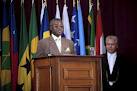
Another African leader, Ethiopian Prime Minister Zenawi, dies 57.
By John Chola – 21/08/2012
 Ethiopian Prime Minister Meles Zenawi has died in hospital abroad, the government said Tuesday.
This is after weeks of speculation about his health.
He was admitted to hospital in July and since then the nature of his condition has not been made public.
"Prime Minister Meles Zenawi passed away yesterday evening at around midnight," spokesman, Bereket Simon said, adding that the 57-year-old "was abroad" when he died, without giving further details.
Meles had not been seen in public for two months, and had been reported to have been sick in a hospital in Brussels, although Bereket gave no details of the illness.
"He had been recuperating well, but suddenly something happened and he had to be rushed to the ICU (intensive care unit) and they couldn't keep him alive."
According to Ethiopia's constitution, Deputy Prime Minister Hailemariam Desalegn is to "act on behalf of the Prime Minister in his absence".
• Mels Zenawi Asresnhas been Prime Minister of Ethiopia since 1995. He was President of Ethiopia from 1991 to 1995.
• Born: May 8, 1955 (age 57), Adwa
• Party: Tigrayan People’s Liberation Front
• Education: Addis Ababa University (1974), Erasmus University, Open University
Analysts say it has not been clear how the government has been run since Meles was reported to have fallen sick in June.
The position of president is largely honorific and Meles, a former rebel fighter who came to power in 1991 after toppling the bloody dictatorship of Mengistu Haile Mariam, held the real political power.
Just about a month ago on July 24, 2012 Ghana's President John Atta Mills died suddenly.

Barrick Gold explores sale of 74 per cent Africa shares.
By Editor – 20/08/12
Owners of Zambia's Lumwana Mine Barrick Gold, the Canadian mining group, confirmed last week Thursday it is in discussions to sell a 74 per cent stake in African Barrick Gold to a Chinese company.
Toronto-based Barrick said talks were under way with China National Gold Group Corporation, a Beijing based mining group, but that they were at a preliminary stage.
However, one person with knowledge of the discussions has told the Financial Times that Zijin Mining Group, the Chinese copper and gold miner, had also indicated a preliminary interest in African Barrick.
According to people familiar with the matter, Barrick has been working with UBS to consider its options for African Barrick, which the Canadian miner, the largest gold producer globally, partially floated in 2010.
China Gold, which has subsidiaries listed in Hong Kong and Toronto and on Beijing’s A share market, is the biggest producer of gold in China and in 2007 set a target to quadruple assets and revenues within four years.
African Barrick, Tanzania’s largest gold producer, has performed poorly since being spun off from its Canadian parent in 2010, with its shares slumping about 30 per cent since listing.
An offer for Barrick’s stake in African Barrick could trigger an offer for the whole of the London-listed company, people familiar with the matter said, putting the onus on its independent directors to safeguard minority owners’ interests.
The UK-listed miner’s shares surged more than 11 per cent to 437.6p in early trading on Thursday.
The Financial Times says Barrick Gold recently signalled it was reining in its expansion plans and introducing a renewed focus on disciplined spending, as it announced a big cost over-run at its key development project in South America.
Jamie Sokalsky, the new Barrick chief executive, pledged that “returns will drive production; production will not drive returns” as he unveiled a review of the miner’s sprawling portfolio of assets.
The Chinese group has, thus far, had a limited profile on the world stage. In August, Zijin said it had bought more than 50 per cent of Norton Gold Fields, an Australian company, calling the move “the first successful example for Chinese enterprise to take over large-sized gold mine in production”….FT
Saturday, August 18, 2012
Global Peace and Justice blamed President Zuma, ANC for massacre of 34 workers at Lonmin mine in Marikana.

Thursday, August 16, 2012
Rhumba star Koffi Olomide indicted.
By John Chola
17/08/12
Democratic Republic of Congo renowned Rhumba star Koffi Olomide has been indicted for assault and battery.
Wednesday, August 15, 2012
Should journalists convey emotion when covering crisis events – like police teargasing supporters of opposition UPND Hakainde Hichilema at Lusaka Central Police?
By JCN’s/IJNet
In the aftermath of the recent teargasing of supporters of UPND leader Hakainde Hichilema and the earthquake in China, many radio reports coming out of Sichuan province and Lusaka respectively featured journalists who were outwardly distraught and emotional; National Public Radio reporters Robert Siegel and Melissa Block, from the U.S., admitted they got “choked up” and even cried on air, which they said made their coverage of the devastation more real. A young female radio journalist covering the event at Lusaka Central Police admitted too she got “chocked” and even cried on air. Should journalists convey emotion when covering crisis events?
Friday, July 27, 2012
Zim Central Bank Chief warn against rushing banks seizure.
By John Chola.
28/07/12
Nyanga - Zimbabwe's central bank chief warned on Friday against rushing the government’s planned seizure of majority stakes in foreign-owned banks.
Gideon Gono is reported saying the country's fragile economy could grind to a halt if the government goes ahead with the planned move.
Gono was speaking to business executives at the annual congress of the Confederation of Zimbabwe Industries in the eastern resort town of Nyanga.
 "The implementation of indigenisation and economic empowerment regulations in the banking sector should be done in a manner that preserves confidence since any adverse developments in the banking sector could grind economic activity to a screeching halt," Gideon Gono said.
Zimbabwe passed in 2007 a law that forces all foreign-owned companies to hand over a majority stake of 51% to locals.
The law has forced mining firms, including the country's biggest platinum mine Zimplats, a subsidiary of South Africa's Impala Platinum, to submit schedules on how they will surrender a majority share.
"We are gratified to note that some aspects of the indigenisation and economic empowerment regulations are receiving attention with a view to harmonize and fine-tune pertinent issues," Gono said.
Indigenisation Minister Saviour Kasukuwere, in a government notice made public earlier this month, gave foreign banks and other companies one year to cede a 51% stake to locals, as required under current laws.
Mugabe's partner in a coalition government, Prime Minister Morgan Tsvangirai dismissed the ultimatum on the banks as illegal and a threat to the ailing economy's recovery prospects.
Britain's Standard Chartered Bank and Barclays Bank are among the major foreign banks with operations in this former British colony.
Ends/

Monday, May 28, 2012
Trafigura and Gunvor SA to supply oil to Zambia

Zambian stock exchange orders Shoprite Group to pay local shareholders SA R7.4 million (K5.2 billion).
By SPECIAL CORRESPONDENT.
The Lusaka Stock Exchange has publicly censured Shoprite Holdings and its subsidiary Shoprite Checkers for breaching rules governing for listing of securities on LuSE in relation to the declaration of dividends.
According to information available at the Lusaka bourse, the listing committee of the LuSE board resolved that the Shoprite Group collectively breached rules 3.1 and 3.28 in relation to non-payment of the dividends as earlier declared by the defaulter.
This was resolved on May 16 this year. The committee considered the matter in the wake of the Shoprite Group failure to honour their November 16 2011 declaration made during the Annual General Meeting undertaking to pay dividends which were due in September last year and April this year.
The committee had the resolution in exercise of its powers provided in section 1 of the Listing Rules and “hereby directs SHL to remedy its breaches by way of effecting full settlement of the dividends outstanding to the LuSE shareholders within 14 days of this notice” issued on May 24 this year.
“The Lusaka Stock Exchange publicly censures Shoprite Holdings Limited (SHL) and its subsidiary Shoprite Checkers Limited (SCL) and their Directors for breaches of the rules governing the listing of securities on the LuSE and the undertaking with regards to Directors given to the Exchange in the form set out in schedule 7 of the Listing Rules,” the censure reads in part.
As it has turned out, a section of shareholders who purchased shares on LuSE were duly issued by SCL in Zambia were not paid.
The total amount the LuSE shareholders are owed is SA R7.4 million (K5.2 billion). In September they were entitled to R1.65 while in April this year Shoprite Group should have paid R1.09 for each of the 2.7 million shares that the transfer agents sold on the Zambian market.
The sale was conducted through a secondary floatation as SHL primarily issued the shares to its subsidiary SCL making the transaction secondary on the Lusaka market.
The Zambian media had reported in March the shareholders were contemplating seeking legal redress to compel Shoprite Group to pay them their dues .
The LuSE notes that the Shoprite Group instead paid other shareholders to the exclusion of the Zambia-based shareholders who bought the shares in the ordinary course of trading business. It has been established that only Namibia and South Africa shareholders were paid their dividends while their Zambian counterparts have to this day not been paid.
The grounds of the censure notes; “the sale, following which the LuSE shareholders acquired ownership of shares in SHL, was authorized and sanctioned by SCL through its appointed agents, Lewis Nathan , acting as its transfer secretary.
“The LuSE shareholders purchased the shares as bona fide purchasers in open market without notice of any defect in the authority of the transfer agent appointed by SCL, and the transfer agent was at all times [presumed to have ostensible or apparent authority to sell the shares at the price at which they were offered,” the LuSE media release reads.
The LuSE also directed that Shoprite Group contention that the mandate to pay the dividends were subject to a court action as null and void.
The Lusaka bourse has therefore noted in its censure that the court dispute has nothing to do with the right of shareholders to be paid their dividends and thus the default could not be sustained by the matter in court in the absence of an order stating so.
Shoprite Group had obtained an injunction and freezing order against its transfer secretary who have however successfully challenged the order in the Kitwe High Court.
Similarly, the transfer secretary quashed a Shoprite Group originated complaint through a Lusaka High Court Judicial Review following the Drug Enforcement Commission seizure of the same accounts at which were at issue in the Kitwe court.
While legal experts expected DEC to file a complaint showing origination and its attendant indictment documentation, the Attorney General’s chambers could not as the Commission never provided such affidavit.
This prompted Justice Christine Phiri to order the defreezingf the accounts and stated that the action was illogical and that the action was beyond the scope of investigations.
While alive the fact that a Judicial Review has no effect of ‘arresting” criminal investigations, DEC has however failed to challenge the judgment which also names some investigations officer, Frederick Chishala of having had lied on oath in a sworn affidavit.
Saturday, April 28, 2012
Zambia maintain end-year inflation target at 7.0%
By John Chola
Zambia has maintained its end-year inflation target at 7.0 per cent.
And the Monetary Policy Committee at its meeting held Friday 27, 2012 anticipates that Zambia’s international trade performance is expected to remain favourable in May 2012, mainly owing to an expected increase in merchandise export earnings.
The Committee observed that global prospects are gradually strengthening though the economic recovery in industrialised economies remains fragile. In this regard,
It says in addition, the continued favourable macroeconomic environment and positive sentiments regarding the economy are expected to have a positive influence on the supply of foreign exchange, and consequently have a moderating effect on inflation.
The Bank of Zambia believes that although liquidity conditions in the money market are expected to ease in May 2012, threats to inflation will remain minimal.
The Central Bank also says domestic credit growth is likely to remain within the projected path hence making the inflation target of 7 per cent a reality.
The Central Bank is however concerned that the expected improvement in the supply of maize, fish and fresh vegetables on account of seasonal factors in the second quarter is expected to dampen food inflation.
“These developments are expected to mitigate the lagged pass-through effects of the exchange rate depreciation experienced in the first quarter of 2012. In this regard, the Committee has weighed the inflation risks and has determined that inflation during the policy-relevant period would remain consistent with the end year target of 7.0 per cent.”
And the Committee has decided to maintain the Bank of Zambia Policy Rate at 9.0 per cent for the month of May.
The next meeting of the Monetary Policy Committee to review of the Policy Rate will be held at the end of May 2012.
End...
Saturday, March 24, 2012
Zambia in a US$ 355 million US 5-year grant.
By John Chola Lusaka - March 23, 2012
If truly the PF government would translate its "immune" to corruption statements into ensuring prudence and commitment to developmental projects, then the wide spread inaccess to clean water and sanitation as well as the sturbon flooding that most Lusaka residents have come to know as the nomal way of living would soon be a thing of the past.
This follows the announcement yesterday by the United States government through the Millennium Challenge Corporation (MCC) to give Zambia a US$ 355 million Compact grant translating into K1.9 trillion at the current prevailing exchange rate.
The MCC Board of Directors chaired by U.S Secretary of State Hillary Clinton made the announcement yesterday and immediately communicated the decision to the Zambian government.US Ambassador to Zambia Mark Storella said the money was being given as a grant to lay the foundation for systemic and lasting change in Lusaka's water, sanitation and dranage system.
And speaking when he announced the awarding of the grant, MCC Chief Executive Officer Daniel Yohannes said, "We congratulate the Zambian people and the government. MCC investments are expected to have a meaningful impact on the lives of more than one million Lusaka residents by improving their health and economic productivity and helping the country reduce poverty on a sustainable basis by enhancing water security."
Ambassador Storella emphasised that relable water and sanitation and drainage systes were a vital components for sustainable development hence the grant given.
With this high ammount of non repayable green backs granted to Zambia, the country would now be able to increase Lusaka's overal water supply, extend and provide city residents greater access to water and better water supply, sanitation and drainage services.
Zambia does not also have to worry if it lacks technical capacity in improving citizen's access to clean running water, sanitation and state of the art drainage system as the Compact also comes with free technical assistance to deepen government-led sector reforms.
The US government is especially intrested in seeing that the PF government ensures not the already privillaged communities but more women and the vulnerable populations benefit from its projecct investments.
The MCC had been rendering constant support to Zambia for the past two years especially through the Ministry of Finance and National Planing to help the country meet stringent MCC Compact eligibility requirements.
The US$355 million is under the five-year Compact agreement with Zambia.
Ends...
Monday, March 19, 2012
LAP GreenN challenge the Zambian Government's action to seize its 75% share in Zamtel
By John Chola
Monday 19 March, 2012 - LAP GreenN, the Libyan Investment Authority's international telecommunications arm, has today successfully filed court papers challenging the Zambian Government's action to seize LAP GreenN's 75 per cent share in Zamtel.In a petition filed before the Zambian High Court, LAP GreenN disputes the legality of the Zambian Government's claim that LAP GreenN's shares were taken for 'public purpose'.Wafik Al-Shater, Chairman of LAP GreenN, said: "LAP GreenN is very clear that the seizure of our shareholding in Zamtel by the Zambian Government was illegal and unconstitutional, and to the detriment of both Zamtel and its customers".Al-Shater said that in the 18 months that Zamtel was under LAP GreenN's management, the telecoms firm increased its total subscriber base by 600 per cent - to over one million at the start of 2012 - and significantly increased the company's market share, leading to a 50 per cent increase in revenues. He stated that the growth and prosperity seen in Zamtel was only recorded under LAP Green management.Mr Al-Shater said that through major improvements and upgrades in systems and infrastructure, including a 100 per cent increase in the number of base stantions, LAP GreenN improved network performance and established a far superior service for Zamtel's customers. "LAP GreenN took a bankrupt company and developed it into a strong telecommunications provider able to deliver real value to all shareholders, to serve the Zambian people and to contribute directly to the Zambian economy sustainably into the future."We are compelled to take this course of action as dictated by the procedure set out in Zambian law. Nevertheless, we sincerely hope that reason can prevail, and that LAP GreenN can resume making its important contribution to providing telecommunications services to the Zambian people. However, to recover the company's significant investment in Zamtel, LAP GreenN will consider any and all legal options available, if necessary, whether in Zambia or in other jurisdictions."The petition filed today outlines LAP GreenN's right to financial compensation for the value of the asset at the time of seizure should the shareholding not be restored to it, which is calculated to be US$480 million. In addition, LAP GreenN is claiming for the substantial losses it has suffered as a result of the seizure of the shares.In June 2010 LAP GreenN acquired a 75 per cent stake in Zamtel, the former state-owned Zambian telecommunications company, for US$ 257 million. The Government of Zambia retained a 25 per cent stake in the company.LAP GreenN is the telecommunications investment arm of Libyan African Investment Portfolio (LAP), focusing on the telecommunications sector in emerging markets. It operates mobile and ISP businesses in Uganda, Zambia, Ivory Coast and South Sudan. LAP GreenN is actively seeking to increase its footprint across Africa and the Middle East.ENDS
Wednesday, February 15, 2012
African champions Zambia on the rise

Monday, February 13, 2012
Zambia are new champions of Africa


Friday, February 10, 2012
Zambia remains a source for women and children trafficking.
................ as Law Enforcement Officers Train to Implement Counter Trafficking Law
By John Chola
Lusaka, Zambia - February 10, 2012
Zambia has continued being used as a source, transit and destination country for men, women, and children subjected to forced labour and sex trafficking across the world.
This is despite Zambia having enacted its first anti human trafficking legislation four years ago.
According to the US State Department’s 2011 Trafficking in Persons Report, albeit Zambia enactment the 2008 anti-trafficking law, its implementation has been challenging.
IOM Zambia Chief of Mission Andrew Choga says his organisation is committed to supporting the government in the implementation of the law.
He was speaking when IOM conducted a training of trainers (ToT) for law enforcement officers in Zambia, using a newly developed handbook on the country’s 2008 Anti-Human Trafficking Act.
 The five-day training, held at the National Police Training College in the capital Lusaka was designed to provide participants with the necessary skills to train other law enforcement officers on how to implement Zambia’s anti-human trafficking law.
Choga says the course focused on the need for sensitivity in dealing with victims of human trafficking.
Eighteen law enforcement officers from the Zambia Police, the Department of Immigration and the Ministry of Home Affairs Research and Planning Unit (HARID) received the training.
The training handbook was developed by IOM in close coordination with the Law Enforcement Expert Group, composed of law enforcement officers from the Zambian Ministry of Home Affairs and other relevant institutions, brought together specifically for this purpose.
The handbook includes chapters on the definition of trafficking in persons, victim identification and treatment, human trafficking investigation, as well as case studies and practical exercises.
The trained officers will in turn train 100 additional officers across the country, with support from IOM.
Ends......////

Wednesday, February 8, 2012
Minister of Commerce Trade and Industry Robert Sichinga lied?
By Staff writter - 08/02/12
Recentry Commerce, Trade and Indury Minister Robert Sichinga was reported to have said that the former ruling MMD printed fake Kwacha in China ammounting to K3 trillion. I thought this was quite an awesome story. As a careful Journalist though never posted the story online. I told the Minister that I needed to see some of the fake Kwacha shown to me by him. He hasent yet done so. I approached some of the commercial banks in a bid that I could show me part of the Sichinga contraband, they couldn't and then I announced was about to loose confidence in the Reserve Bank which I have delt with for over 10 years as one of my best sources of information. Now yesterday the bank officially told me personally that it is not aware of any fake Kwacha printed in China and injected into the market illegally. If this is done would shock or distort the money markets. I am now left wondering whether Minister Sichinga will rank among those who like terming me a Journalist who can never just get whatever an official says as gospel truth but keeps asking unnecessary questions to verify the authentisit of their raw informatio or data. Will Minister Sichinga blame me if I throw it right in his face that I no longer have confidence in him? That I actually hate liers like him? That he is not fit to hold a government ministerial position as he is uncredible? That every time he will speak I will never take him serious as he is now tossed into the same basket where some of those he accused now belong? That I have statrted loosing confidence in the whole PF government because of statement such as his? That whatever the Ministers pronnounce have a great pottential of being lies? Will he blame me for regarding him one of a type of Fake Economists who dream speak without considering any reality of what they say? Will Minister Sichinga blame citizens of Zambia of propagatting hatrade against him and the overwhelmingly voted for PF government if they passed a vote of no confidence because of statement such as his and ask him to step aside to face personal litigations resulting from officially refuted pronnouncements? Am just wondering also if his ba Sebele - the President- dropped him until his now refuted claims are substantiated would he complain? I mean how could just Bob make such a statement from without and for what? Aren't these types of politics thrown into the bin by Zambians since September 2011? I thought as Minister Bob who I have interviewed countless times now in my career and sort of respected to be meticulous would only make pronnouncements after verifying everything and interogating issues propery! Are these not the same things he would go to town about when he was independent MP, consultant and opposition UPND? So can we still ask him as Journalists to really substantiate his earlier claims and prove the Authority on monetary matters - Reserve bank - wrong so that we can loose complete confidence in the colleagues we have lots of respect for at Central bank? Ohhh! I hear that now he has been sued by those he accused.
Saturday, February 4, 2012
Zambia’s Competition and Consumer Protection unit tips manufacturers ……..as large mines shun inefficient local suppliers.
By John Chola – January 4, 2012.
Zambia’s Competition and Consumer Protection Commission has found that the mining companies that sought merger authorizations from it are complying with the law and conditions given to them.
CCPC Executive Director Chilufya Sampa says among the conditions given to the mining companies were that the merged entities should honour agreements that the firms had entered into with local suppliers to the mines before the merger.
Earlier the Commission demanded that the merged entities should take reasonable steps to ensure that jobs and investments were created by virtue of the transactions being authorised.
The Commission has meanwhile committed to continue monitoring not only the mining sector but every other sector that has competition concerns to ensure that a level playing field is created.
Meanwhile Sampa has told this newswire that the Commission and Consumer Protection Commission has over the last few months received a number of complaints from mine suppliers, that most of the major mine contracts are given to foreign firms and not local firms.
Following the complaints CCPC from January 9, to 20th, 2012 undertook a tour of the Copperbelt and North Western Provinces to verify and have first hand information on these allegations.
The Commission has since learnt that mines give most contracts to foreign owned companies owing to Zambia’s lack of a large manufacturing base.
He says the local mine suppliers rely on manufacturers outside the country making them uncompetitive because they compete with authorised distributors of these goods or the original manufacturer of the goods.
“For as long as Zambians do not take to manufacturing their own equipment, the mines will always favour importing from the Original Equipment Manufacturers (OEMs) because they are cheaper”, the CCPC Executive Director observed.
The Commission team had several meetings with different mines and relevant stakeholders including the mine suppliers.
Sampa says the Commission noted that most mine suppliers do not have adequate capital making them to usually rely on a down payment before they could supply any goods.
In addition, it has been observed that since local suppliers do not have well established distribution networks with the Original Equipment Manufacturers, they usually fail to provide goods and services in good time.
“I would encourage the Zambia Association Manufactures and all other mine suppliers to seriously consider setting up manufacturing plants for some of the products being supplied to the mines. In a liberal economy, you do not necessarily need to wait for Government to tell you what you should do but for the private sector to recognize market niches and take advantage of such openings”, Sampa said.
End….//
Subscribe to:
Posts (Atom)